
A golden crown over the word Pendragon

Welcome to the new Pendragon Website!

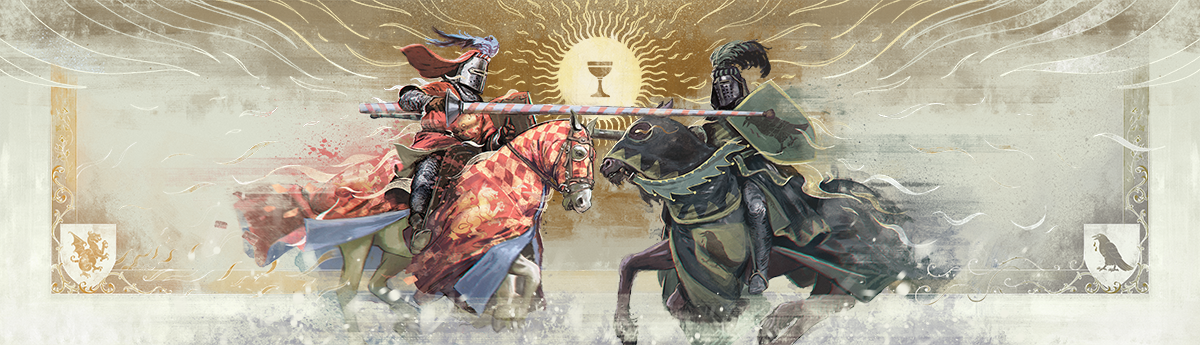
What kind of Knight will you become?

We are proud to present the new Pendragon website as a central hub for all things valorous. Here you will find everything you need to enjoy the full experience of the Pendragon Roleplaying Game - a game of Arthurian legends.

Take time to explore the site. You will find content on a variety of topics for people both new to the game and roleplaying, and those more experienced.

  • Articles from life in the age of Arthurian legends, on chivalry and honour, to how to bring to life the emotional impact of play at your gaming table
  • Pregenerated characters, maps, and other reference material
  • A Pendragon wiki to help answer quick rules questions
  • Links back to how to purchase the Pendragon books in our store and where to play it online with virtual tabletops
  • Links for where to take part in the Pendragon community on Discord, Facebook, BRP Central, and others
  • Instructions on how to join The Companions of Arthur community content program to publish your own scenarios and get paid for it!

Pendragon is a world of brutal medieval realism that focuses on the emotional impact of play and strives to make players feel as invested, loving, and frightened about their characters as their characters themselves would feel. Pendragon is a game that walks a fine line between lethal reality and the idealism of a visionary life dedicated to the highest values.

Please join the Pendragon community and become the Knight you were meant to be!

Don Ford

Age of Vikings Community Ambassaor and Sagas of the North Community Content Creator

Don joined Chaosium as community ambassador for the new program we are setting up for Age of Vikings. A GM and player of RuneQuest for over 40 years, at Chaosium Con UK 2025, he fell in love with the Age of Vikings roleplaying game.

What is Pendragon?

Pendragon Shield Arthur's Coat of Arms

Experience the emotional depth and chivalric ideals of King Arthur’s Britain.


"One land, one king! That is my peace."

– Uther Pendragon, Excalibur (1981)


Pendragon is Greg Stafford’s role-playing game of knights in the age of King Arthur. It blends actual history, medieval romances, and modern fiction relating to Arthur and the knights of the Round Table and places the player-character among these storied figures. Everyone plays a knight, but not all knights are the same—far from it!

Thanks to Pendragon’s ground-breaking system of Traits and Passions, one knight might aspire to the ideals of chivalry and faith while his companion nurses an overwhelming vengeful grudge against those who wronged her. Passions like Homage, Adoration, and Hate drive knights to nearly superhuman feats of prowess and bravery, but also saddle them with spells of melancholy and even madness. Characters in Pendragon are truly larger than life, and the system is engineered to drive memorable moments of heroism and tragedy, just like the Arthurian tales that inspired the game.

What’s more, characters age over the course of a campaign, eventually meeting their ends either in combat or thanks to old age, leaving their legacies to their offspring to carry on. A full Pendragon campaign can span decades of time in which you might play three generations of knights who collectively witness Arthur draw the sword from the stone, found the Round Table, and inaugurate an era of adventure culminating in the quest for the Holy Grail, only to see it all crumble as the Round Table fractures thanks to the schemes of Arthur’s perfidious son, Mordred.

As these greater events play out around your characters, you will inherit and manage your own manor (and perhaps gain enough land to build a castle!), grow your family and household, lead armies, and—most importantly—gain Glory as you navigate both the halls of power and mist-shrouded enchanted forests of Britain.

As knights, your duty is to put yourselves in harm’s way to protect those weaker than you, and death is always hair’s breadth away thanks to the game’s fast yet brutal combat system. This is a game of deep passions and meaningful consequences, both on and off the battlefield.

So what are you waiting for? Swear homage to your lord, take up your sword, and discover why Pendragon is routinely counted among the greatest role-playing games of all time.

David Larkins

David Larkins is Creative Director for Chaosium's Pendragon roleplaying game.

A longtime fan of the BRP family of games and, it was his privilege to connect with Greg Stafford back in 2014 and begin contributing as a writer and editor to the revitalized Pendragon line. Nowadays, David carries forward the game's legacy in the wake of Greg's passing as Greg's nominated literary heir.

Stories Driven by Passion and Virtue

What kind of knight will you become?

One of Pendragon’s defining elements—perhaps the defining element—is its system of Traits and Passions.

Unlike other games in the Basic Roleplaying family, Pendragon lacks any Characteristic for defining your non-physical attributes. Numbers measure your Strength, your Constitution, your Appeal, and so forth, but there is no Intelligence or Power score. Why is this?

It’s because Traits and Passions define how you feel, and often how you behave. They take the place of the intangible Characteristics and create a multifaceted nuance that goes beyond a mere Intelligence or Power score. They are there to push you, sometimes subtly, sometimes overtly, to engage with the world of Arthur’s Britain in a manner consistent with the characters who people Arthurian tales

Traits and Passions shape every decision, triumph, and tragedy.

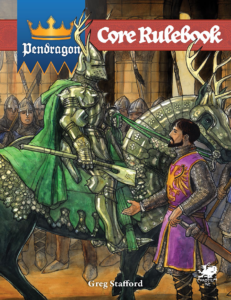
To quote the Pendragon Core Rulebook:

Commoners scowl and growl at each other when angry, and wail and blubber when they are sad. Knights love their brothers and sisters in arms, laugh raucously together, and weep when a good one dies. King Arthur falls from his throne onto the floor shaking with laughter when some foppery occurs at court. He rages when a foreign king insults him or his kingdom. He weeps when his knights go off on the Quest for the Holy Grail—afraid he will never see such noble warriors together again. Overt displays of Passions are normal. People are unashamed to show their feelings.

Traits comprise thirteen matched pairs, rated on a scale totaling 20; when one side of the pair goes up (your Forgiving increases to 13, say), the other side of the pair goes down (your Vengeful becomes a 7). Passions stand on their own, though they are grouped into thematic “courts” that place a cap on having too many of similar type; Passions, too, are rated on a scale of 1–20.

There are game-mechanical benefits to Traits and, especially, Passions, providing inspirational bonuses to Skills in times of crisis. But the values of your Traits and Passions also serve as a guide to roleplaying, also respond to your own choices in the game. In the above example, your Forgiving might have increased because that’s how you’re playing your character or because you rolled a critical Forgiving success.

But as Traits and Passions reach values of 16 or higher, they threaten to take on a life of their own. Once your Trait or Passion becomes “Famous,” you must either act in accordance with it at all times or try your luck with the dice in an attempt to resist the urge to do so. And once that Trait or Passion reaches 20 or higher (“Exalted” level), you have no choice but to follow its whims!

This is, of course, not always a bad thing! A Famously Forgiving knight will be celebrated by many, and no doubt many a fellow knight will owe them Favors. But what happens when you have a chance to finally smite the mortal enemy of your family who has caused you incalculable harm? Will your Forgiving Trait stay your sword?

It is through this combination of dice rolls and in-game character decisions that your Traits and Passions grow and change over the course of the campaign. In concert with how you choose to focus your Skill training, and how you spend your Prestige Rewards gained from accruing Glory, you get to know your character and find out just what kind of knight they are becoming.

David Larkins

David Larkins is Creative Director for Chaosium's Pendragon roleplaying game.

A longtime fan of the BRP family of games and, it was his privilege to connect with Greg Stafford back in 2014 and begin contributing as a writer and editor to the revitalized Pendragon line. Nowadays, David carries forward the game's legacy in the wake of Greg's passing as Greg's nominated literary heir.

The Winter Phase

Plan Your First Winter Phase

For gamers accustomed to campaign-style play where one adventure leads directly into the next, Pendragon’s assumption of one adventure per game-year may come as something of a surprise.

There are two reasons the game is structured like this: First, it ensures characters age, reinforcing the generational element of game play; second, it creates space for the Winter Phase, the time in the game when characters improve their Skills, manage their households and families, and tally Glory.

Like the development phases found in Call of Cthulhu and RuneQuest, the Winter Phase is when you as the Player get to roll against all the Skills, Traits, and Passions you “checked” over the course of the previous year to see if they improve. But you can also guide your character growth with Training and Practice, which allows you to build up your Characteristics as well as your Skills, Traits, and Passions, depending on preference and age.

And speaking of self-improvement, one of my favorite parts of the Winter Phase is the opportunity to run Solo Scenarios. At their most basic level, Solos function as “make-up work” for Players who missed the previous year’s events. It is an elegant workaround to the age-old problem of how to handle missing Players at the table, and adds a narrative element as the Player-knight discovers just how they spent the year and what opportunities for growth presented themselves. Some Solos are mandatory, even if the Player was present, such as for characters lost to Madness or those playing at the baronial level (as detailed in the Pendragon Noble’s Handbook).

Regardless, everyone also gets to roll on the Personal Events table, adding another fun bit of flavor to their character history. Perhaps you accidentally conceived a child, or had a bad run-in with a wild boar while out hunting; or maybe you went on a pilgrimage or lost Honor after revealing embarrassing secrets about your lord. There are literally dozens of potential events, any of which could spawn their own plot threads in the years to come.

The Winter Phase isn’t without its moments of tension, either. Every year, your Player-knight must roll to see if they lose members of their household. In the core game, this comprises survival rolls for your character’s young offspring and favorite mount(s). Particularly old and infirm Player-knights might at last meet their final rest if the dreaded Aging Roll reduces their Constitution to zero! If using the Expanded Winter Phase options in the Noble’s Handbook, these potential losses extend to spouses, parents, aunts, uncles, cousins…

These rolls are never made without a certain level of tension, even though (most years) those nearest and dearest to you will survive. But there’s always a chance, and that’s part of what keeps the Winter Phase exciting and engaging.

At last, there’s that thing that all knights covet: Glory. Player-knights officially earn the Glory they accrued in the prior year’s adventure and add it to their running total, as well as their Passive Glory earned from exceptional Traits and Passions, standard of living, and notable Appeal. Once these are added, if total Glory crosses a 1,000-point threshold, the character earns a Prestige Reward.

Prestige Rewards can be used to improve any Statistic (Characteristic, Skill, Trait, or Passion) by one point, regardless of normal limitations, or lower a Passion by one point (sometimes desirable if said Passion has been getting your character in trouble of late), or, perhaps most significantly, guarantee the birth of an heir or healthy birth of another child. The question of whether to spend a Prestige Reward right away or hold onto it for future use is a wonderful problem to have!

The Winter Phase can be played outside a regular game session, and for those who play shorter sessions this is likely preferable, but I always encourage folks to game out the winter at the table if at all possible. I’ve had many memorable Pendragon moments arise from Winter Phase events and the roleplaying they inspire, and I hope you’ll have as much fun with it as I do.

David Larkins

David Larkins is Creative Director for Chaosium's Pendragon roleplaying game.

A longtime fan of the BRP family of games and, it was his privilege to connect with Greg Stafford back in 2014 and begin contributing as a writer and editor to the revitalized Pendragon line. Nowadays, David carries forward the game's legacy in the wake of Greg's passing as Greg's nominated literary heir.