
You only need a few things to start playing
-
If you’re playing in person, writing materials, paper, and standard gaming dice (including the percentile dice). Ideally every player will have their own set of dice, but you can share.
-
Next, you’ll need somewhere to play. If you’re playing in person, a table and comfortable
seating for everyone is a must. If you’re playing online, use the voice and/or video
program of your choice. Pendragon is available on online game platforms such as Foundry, Quest Portal and Roll20. -
You’ll need to set aside enough time to play, so plan to spend two to four hours having an adventure with your friends.
-
Finally, you’ll need to decide who you want to play with. A group between three and five players, one of whom must be the gamemaster, is ideal.
Once all that’s done, you’re ready to play!
Game Play in Pendragon
There are only two types of dice used in Pendragon: The twenty-sided (D20) and the six-sided (D6). You use the D20 to resolve actions as well as test your character’s morals and beliefs in times of crisis. The D6 is most often used to determine damage dealt in combat.
The stories of King Arthur and his knights and ladies are filled with characters consumed by their passions and driven by their emotions for good and ill. Throughout the course of this adventure, and later when you play Pendragon with your friends, you will find your character’s personality at times driving the narrative in surprising directions. Much enjoyment is thus derived from trying to get yourself out of trouble of your own devising!
This touches on the central question underlying all gameplay in Pendragon: Finding out what kind of knight you really are.
What Kind of Knight will you Become?
One of Pendragon’s defining elements—perhaps the defining element—is its system of Traits and Passions.
Unlike other games in the Basic Roleplaying family, Pendragon lacks any Characteristic for defining your non-physical attributes. Numbers measure your Strength, your Constitution, your Appeal, and so forth, but there is no Intelligence or Power score. Why is this?
It’s because Traits and Passions define how you feel, and often how you behave. They take the place of the intangible Characteristics and create a multifaceted nuance that goes beyond a mere Intelligence or Power score. They are there to push you, sometimes subtly, sometimes overtly, to engage with the world of Arthur’s Britain in a manner consistent with the characters who people Arthurian tales
Traits and Passions shape every decision, triumph, and tragedy.
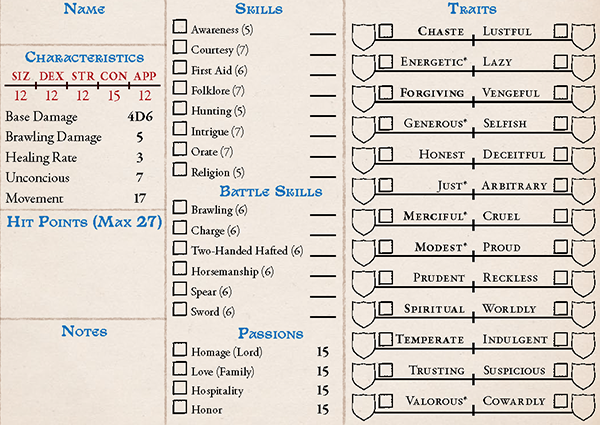
Note: The Character Sheet shown above is a simplified version of the standard Pendragon character sheet (provided in the Pendragon Starter Set for the solo adventure that teaches you the basic rules as you play) - it demonstrates just how much Traits and Passions define how you feel, and often how you behave!
Pre-Generated Characters
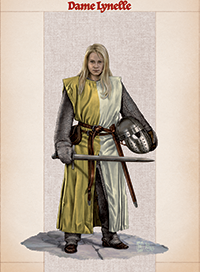
The Resources page provides links to download 8 pre-generated knights to enable you and your friends to charge straight into the action!
As an example this is Dame Lynelle and her sheet
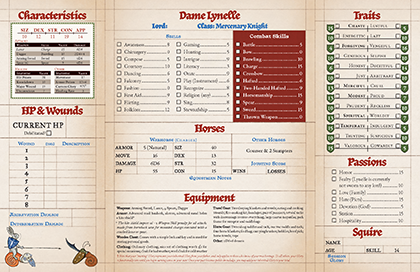
The following rules are summarized from the Pendragon Core Rule Book, Simplified for ease of play
Overview of Rules
Characteristics
Five Characteristics quantify the character’s physical qualities. All knights generate their Characteristics the same way, regardless of gender. It is quite reasonable to assume that female knights are stronger and bigger than the average noblewoman, or they would not have picked this career for themselves.
- Size (SIZ): Measures a character’s relative height and weight compared to others.
- Dexterity (DEX): Measures a character’s agility and nimbleness. DEX keeps a character upright or horsed and is used for starting weapon Skills, throwing things, and other actions determined by the Game Master.
- Strength (STR): Measures a character’s physical power and their ability to exert force or pressure on an object. STR figures into most Combat Actions.
- Constitution (CON): Measures health and vitality. CON is important in determining how much of a beating you can take and how quickly you recover.
- Appeal (APP): Measures the character’s natural charm, presence, and physical attractiveness. APP is used to determine some starting values for Skills that are naturally affected by native charisma and appearance.

Glory and Honor
The measure of all knights is taken by their Glory and Honor values.
Glory is the measure of a knight’s notoriety and fame. It only increases with time and is not tied to the knight’s inherent moral character—knights like Sir Agravaine or Sir Breuse sans Pitie are infamous for their rotten personalities and questionable behavior, but both achieve high Glory values.
Honor, on the other hand, may fluctuate quite a bit over the course of a knight’s lifetime and is dependent on their behavior. Some actions increase Honor; many others decrease it. Honor is a precious commodity and must be closely guarded, for if a knight’s Honor ever falls too low, they lose their status and place in society!
During an adventure, players will keep track of the actions that would normally earn them Glory if they were a knight, as well as their Honor value. This is done by placing checks in the boxes next to the indicated Skills, Personality Traits, and Passions. Each box may only be checked once—if you earn a check earlier in the adventure, any further instructions to check the box are ignored. After completing the adventure, you will find instructions on how to tally everything up based on your checks and find out what kind of knight your young character will eventually grow up to become!
Dealing and Taking Damage
As noted earlier, you roll multiple six-sided dice to determine how much damage is done in combat. Sometimes you add a set number to the total (such as rolling 2D6+4 when brawling with a quarterstaff); other times (like when you throw a punch), you simply apply a set number of points of damage (usually between 4–5, depending on your Size and Strength).
Armor protects against damage, but whatever gets through is deducted from the character’s Hit Points. Hit Points fall below the character’s Unconscious threshold, the character is incapacitated; if Hit Points ever fall to zero or less, the character is dying!
Personality Traits
Personality Traits (often written simply as Traits). These quantify and guide your character’s actions. All Traits come in pairs, with two values that sum to 20. The values of each are written on opposite sides of a slash (/), for instance like 13/7. As one Trait rises, the other falls by an equal amount: 14/6, 15/5, and so on. A character tends to act according to the Trait with the greater value.
The bold Personality Traits are called your “Religious Traits” and represent the values most important to your religion. Other Traits (those marked with a star) are particularly important for knights.
Passions
Passions are intense beliefs that may provide inspiration, boosting a single Skill or Trait for a short time. Passions are especially useful in combat or when attempting a difficult task. If Traits represent your personality, Passions represent the values your character holds most dear. The most important Passion is Honor, and this begins with a value of 15. There are many other Passions, including Adoration, Devotion, Hate, Station, and Chivalry.
Skills
The final step for customizing your character is assigning points to your Skills. As the name implies, Skills are what allow characters to accomplish great deeds in the game. Each Skill has a default value listed on the character sheet in parenthesis. These values are increased in a variety of ways, as outlined below.
Because you are a Cymric knight in training, you add 3 to your Charge, Horsemanship, and Courtesy Skills.
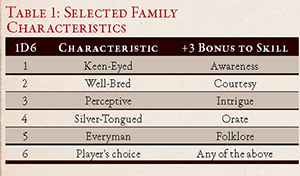
Every family has a certain inborn talent for a particular Skill. Roll 1D6 and consult Table 1: Selected Family Characteristics to find out where your natural talent lies, then increase the indicated Skill by +3.
Now distribute 10 points amongst your Skills with the limitations outlined below. These Personal Skill additions represent where you have put your time and attention as you have grown up at court. As with Passions, not all Skills are useful in every scenario! However, some Skills of use only to knights (such as Stewardship) are not included on this character sheet. For definitions of each Skill, see “Chapter 4: Skills” in Book II.
Skill Limitations
When distributing the points listed below, you must follow these rules:
- No Skill may be raised above 15
- No Skill with a starting value of 0 may be increased
- The following Skills may not be raised above the value of the Appeal Characteristic at the time of character creation: Courtesy, Flirting, Folklore, Intrigue, and Orate
Bonuses from your Cymric Skill Modifiers and Family Characteristics may raise Skill values above the limitations set out above.
Play Pendragon
he Adventure of
the Sword in the Stone
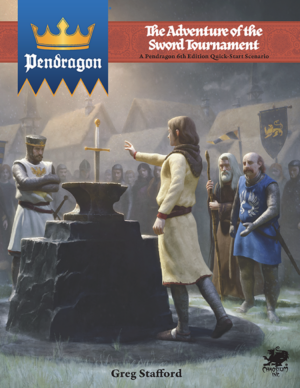
We want you to have a FREE solo scenario that serves as an introduction to the world of Pendragon and the game’s mechanics.
The High King is dead. The realm is broken. A legendary blade awaits its true master, and you are standing at the very epicenter of destiny.
Step into the muddy boots of a 14-year-old page serving Sir Ector alongside your childhood companions, Kay and a quiet squire named Arthur. In this immersive, choice-driven solo adventure, you won’t just read about Arthurian history, you’ll live it.
-
No Game Master Needed: Dive straight into the Pendragon rules through an interactive, Choose-Your-Own-Adventure style tutorial.
-
Test Your Code of Honor: Navigate deadly wilderness hunts, survive sudden skirmishes, and make critical moral choices that test your Passions and Traits.
-
Shape Your Legacy: Your actions at the historic London Tournament trigger a unique endgame scoring system, determining exactly what kind of knight you are destined to become.
The sword is in the stone. History is calling. Will you answer?
Click the button above to get the FREE solo scenario and start playing now!
Play Pendragon with your friends this weekend!

Ready to play scenario
- Take part in the epic moment when an unknown, back-country squire draws the sword from the stone.
- A rules overview covering Traits, Passions, Skills, and combat
- Five pregenerated Player-knights
- A primer on the city of Londinium: the setting for the scenario