


What kind of knight will you become?
One of Pendragon’s defining elements—perhaps the defining element—is its system of Traits and Passions.
Unlike other games in the Basic Roleplaying family, Pendragon lacks any Characteristic for defining your non-physical attributes. Numbers measure your Strength, your Constitution, your Appeal, and so forth, but there is no Intelligence or Power score. Why is this?
It’s because Traits and Passions define how you feel, and often how you behave. They take the place of the intangible Characteristics and create a multifaceted nuance that goes beyond a mere Intelligence or Power score. They are there to push you, sometimes subtly, sometimes overtly, to engage with the world of Arthur’s Britain in a manner consistent with the characters who people Arthurian tales
Traits and Passions shape every decision, triumph, and tragedy.
To quote the Pendragon Core Rulebook:
Commoners scowl and growl at each other when angry, and wail and blubber when they are sad. Knights love their brothers and sisters in arms, laugh raucously together, and weep when a good one dies. King Arthur falls from his throne onto the floor shaking with laughter when some foppery occurs at court. He rages when a foreign king insults him or his kingdom. He weeps when his knights go off on the Quest for the Holy Grail—afraid he will never see such noble warriors together again. Overt displays of Passions are normal. People are unashamed to show their feelings.
Traits comprise thirteen matched pairs, rated on a scale totaling 20; when one side of the pair goes up (your Forgiving increases to 13, say), the other side of the pair goes down (your Vengeful becomes a 7). Passions stand on their own, though they are grouped into thematic “courts” that place a cap on having too many of similar type; Passions, too, are rated on a scale of 1–20.
There are game-mechanical benefits to Traits and, especially, Passions, providing inspirational bonuses to Skills in times of crisis. But the values of your Traits and Passions also serve as a guide to roleplaying, also respond to your own choices in the game. In the above example, your Forgiving might have increased because that’s how you’re playing your character or because you rolled a critical Forgiving success.
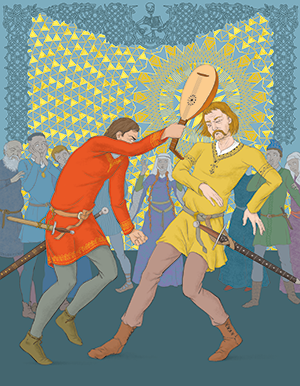
But as Traits and Passions reach values of 16 or higher, they threaten to take on a life of their own. Once your Trait or Passion becomes “Famous,” you must either act in accordance with it at all times or try your luck with the dice in an attempt to resist the urge to do so. And once that Trait or Passion reaches 20 or higher (“Exalted” level), you have no choice but to follow its whims!
This is, of course, not always a bad thing! A Famously Forgiving knight will be celebrated by many, and no doubt many a fellow knight will owe them Favors. But what happens when you have a chance to finally smite the mortal enemy of your family who has caused you incalculable harm? Will your Forgiving Trait stay your sword?
It is through this combination of dice rolls and in-game character decisions that your Traits and Passions grow and change over the course of the campaign. In concert with how you choose to focus your Skill training, and how you spend your Prestige Rewards gained from accruing Glory, you get to know your character and find out just what kind of knight they are becoming.