
Plan Your First Winter Phase
For gamers accustomed to campaign-style play where one adventure leads directly into the next, Pendragon’s assumption of one adventure per game-year may come as something of a surprise.
There are two reasons the game is structured like this: First, it ensures characters age, reinforcing the generational element of game play; second, it creates space for the Winter Phase, the time in the game when characters improve their Skills, manage their households and families, and tally Glory.
Like the development phases found in Call of Cthulhu and RuneQuest, the Winter Phase is when you as the Player get to roll against all the Skills, Traits, and Passions you “checked” over the course of the previous year to see if they improve. But you can also guide your character growth with Training and Practice, which allows you to build up your Characteristics as well as your Skills, Traits, and Passions, depending on preference and age.
And speaking of self-improvement, one of my favorite parts of the Winter Phase is the opportunity to run Solo Scenarios. At their most basic level, Solos function as “make-up work” for Players who missed the previous year’s events. It is an elegant workaround to the age-old problem of how to handle missing Players at the table, and adds a narrative element as the Player-knight discovers just how they spent the year and what opportunities for growth presented themselves. Some Solos are mandatory, even if the Player was present, such as for characters lost to Madness or those playing at the baronial level (as detailed in the Pendragon Noble’s Handbook).
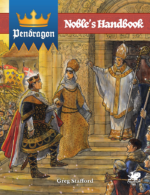
The Pendragon: Noble's Handbook expands the core game experience with a wealth of character options, subsystems, and expansion to the popular Winter Phase.
Regardless, everyone also gets to roll on the Personal Events table, adding another fun bit of flavor to their character history. Perhaps you accidentally conceived a child, or had a bad run-in with a wild boar while out hunting; or maybe you went on a pilgrimage or lost Honor after revealing embarrassing secrets about your lord. There are literally dozens of potential events, any of which could spawn their own plot threads in the years to come.
The Winter Phase isn’t without its moments of tension, either. Every year, your Player-knight must roll to see if they lose members of their household. In the core game, this comprises survival rolls for your character’s young offspring and favorite mount(s). Particularly old and infirm Player-knights might at last meet their final rest if the dreaded Aging Roll reduces their Constitution to zero! If using the Expanded Winter Phase options in the Noble’s Handbook, these potential losses extend to spouses, parents, aunts, uncles, cousins…
These rolls are never made without a certain level of tension, even though (most years) those nearest and dearest to you will survive. But there’s always a chance, and that’s part of what keeps the Winter Phase exciting and engaging.
At last, there’s that thing that all knights covet: Glory. Player-knights officially earn the Glory they accrued in the prior year’s adventure and add it to their running total, as well as their Passive Glory earned from exceptional Traits and Passions, standard of living, and notable Appeal. Once these are added, if total Glory crosses a 1,000-point threshold, the character earns a Prestige Reward.
Prestige Rewards can be used to improve any Statistic (Characteristic, Skill, Trait, or Passion) by one point, regardless of normal limitations, or lower a Passion by one point (sometimes desirable if said Passion has been getting your character in trouble of late), or, perhaps most significantly, guarantee the birth of an heir or healthy birth of another child. The question of whether to spend a Prestige Reward right away or hold onto it for future use is a wonderful problem to have!
The Winter Phase can be played outside a regular game session, and for those who play shorter sessions this is likely preferable, but I always encourage folks to game out the winter at the table if at all possible. I’ve had many memorable Pendragon moments arise from Winter Phase events and the roleplaying they inspire, and I hope you’ll have as much fun with it as I do.